
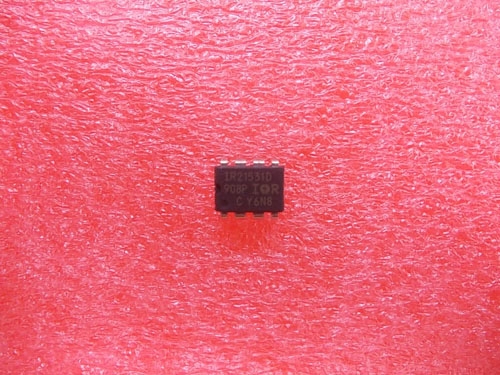
Details
BUY IR21531D https://www.utsource.net/itm/p/12610217.html
| Parameter | Symbol | Min | Typical | Max | Unit | Conditions |
|---|---|---|---|---|---|---|
| Supply Voltage | VDD | 4.5 | - | 20 | V | - |
| High-Side Driver Supply Voltage | VB | 10 | - | 60 | V | - |
| Low-Side Driver Supply Voltage | VSS | 0 | - | -VB | V | - |
| Maximum Continuous Output Current | IOUT | - | 2 | - | A | Continuous, per channel |
| Maximum Peak Output Current | IOUT(PK) | - | 3 | - | A | Peak, per channel |
| Input Logic High Voltage | VIH | 2.0 | - | VDD | V | - |
| Input Logic Low Voltage | VIL | - | - | 0.8 | V | - |
| Propagation Delay | td | - | 50 | - | ns | - |
| Minimum Pulse Width | tmin | 75 | - | - | ns | - |
| Operating Temperature Range | TA | -40 | - | 125 | 掳C | - |
| Storage Temperature Range | TSTG | -65 | - | 150 | 掳C | - |
Instructions for Use:
Power Supply Connections:
- Connect VDD to the supply voltage (4.5V to 20V).
- Connect VB to the high-side driver supply voltage (10V to 60V).
- Connect VSS to the low-side driver supply voltage (0V to -VB).
Input Signal:
- Apply logic high (VIH) and logic low (VIL) signals to the input pins to control the high-side and low-side drivers.
- Ensure that the input signals meet the specified voltage levels to avoid incorrect operation.
Output Current:
- The maximum continuous output current per channel is 2A, and the peak output current can reach up to 3A.
- Do not exceed these limits to prevent damage to the device.
Propagation Delay:
- The typical propagation delay is 50ns. This is the time it takes for the output to respond to an input signal change.
Minimum Pulse Width:
- The minimum pulse width that can be reliably detected is 75ns. Ensure that your control signals have a pulse width greater than this value.
Temperature Considerations:
- The operating temperature range is from -40掳C to 125掳C. Ensure that the device operates within this range to maintain reliability.
- The storage temperature range is from -65掳C to 150掳C. Store the device in this range to prevent damage.
Layout and PCB Design:
- Use proper PCB layout techniques to minimize parasitic inductance and capacitance, which can affect performance.
- Place decoupling capacitors close to the power supply pins to ensure stable operation.
Protection:
- Implement appropriate protection circuits, such as overvoltage and overcurrent protection, to safeguard the device and connected components.
Testing and Debugging:
- Use an oscilloscope to monitor the input and output signals during testing to ensure proper operation.
- Refer to the datasheet for detailed information on testing procedures and troubleshooting tips.
View more about IR21531D on main site