
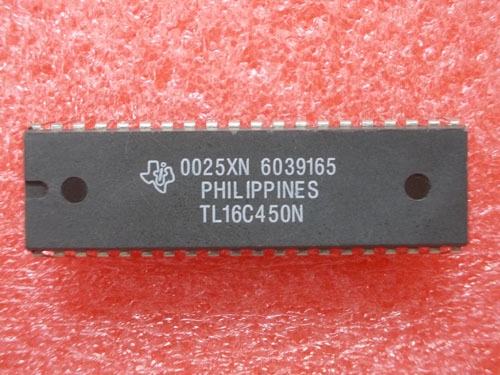
Details
BUY TL16C450N https://www.utsource.net/itm/p/12611789.html
| Parameter | Symbol | Conditions | Min | Typ | Max | Unit |
|---|---|---|---|---|---|---|
| Supply Voltage | VCC | Operating | 4.5 | 5.5 | V | |
| Operating Temperature | -40 | 85 | 掳C | |||
| Storage Temperature | -65 | 150 | 掳C | |||
| Data Rate | 0 | 1.5 | Mbps | |||
| Power Consumption | ICC | No Activity | 0.1 | 0.3 | 1.0 | mA |
| Input High Voltage | VIH | 2.0 | VCC | V | ||
| Input Low Voltage | VIL | 0 | 0.8 | V | ||
| Output High Voltage | VOH | IO = -4mA | 2.4 | VCC - 0.4 | V | |
| Output Low Voltage | VOL | IO = 4mA | 0 | 0.4 | V |
Instructions for Using TL16C450N
Power Supply:
- Connect the VCC pin to a stable 5V power supply.
- Ensure the ground (GND) pin is connected to the system ground.
Clock Configuration:
- The TL16C450N uses an external clock source. Connect the clock signal to the XIN and XOUT pins if using an external crystal or oscillator.
Data and Control Lines:
- Connect the data lines (RXD, TXD) to the corresponding lines of the communication interface.
- Connect control lines (DTR, RTS, CTS, DSR, RI, DCD) as required by your application.
Initialization:
- Use the initialization sequence to configure the UART settings such as baud rate, word length, stop bits, and parity.
- Write to the Line Control Register (LCR) to set the desired configuration.
Transmitting Data:
- Write data to the Transmitter Holding Register (THR) to send data.
- Check the status of the Transmitter Holding Register Empty (THRE) bit in the Line Status Register (LSR) to ensure the register is empty before writing new data.
Receiving Data:
- Read data from the Receiver Buffer Register (RBR) when the Data Ready (DR) bit in the LSR is set.
- Clear the DR bit by reading the RBR.
Interrupt Handling:
- Configure the Interrupt Enable Register (IER) to enable specific interrupts.
- Read the Interrupt Identification Register (IIR) to determine the cause of the interrupt.
- Service the interrupt and clear the appropriate status bits.
Error Handling:
- Monitor the Line Status Register (LSR) for error conditions such as Overrun Error, Parity Error, and Framing Error.
- Take appropriate action to handle errors, such as retransmitting data or resetting the UART.
Power Management:
- To reduce power consumption, disable unused features and set the UART to a low-power mode when not in use.
Testing and Debugging:
- Use a loopback test to verify the functionality of the UART. Connect the TXD pin to the RXD pin and transmit data to see if it is received correctly.
- Use an oscilloscope or logic analyzer to monitor the signals on the data and control lines for proper operation.
For detailed information and advanced configurations, refer to the datasheet provided by the manufacturer.
(For reference only)View more about TL16C450N on main site