
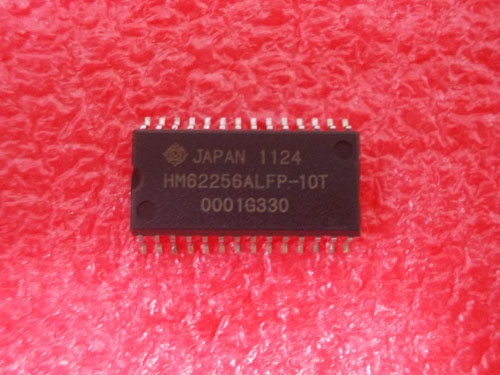
Details
BUY HM62256ALFP-10T https://www.utsource.net/itm/p/12612012.html
| Parameter | Description | Value | Unit |
|---|---|---|---|
| Device Type | Memory Type | SRAM (Static Random Access Memory) | - |
| Capacity | Storage Capacity | 32 K x 8 bits | - |
| Supply Voltage (VCC) | Operating Range | 4.5 to 5.5 | V |
| Supply Current (ICC) | Active Mode | 10 | mA |
| Supply Current (ICC) | Standby Mode | 0.1 | 渭A |
| Access Time (tAA) | Typical | 100 | ns |
| Data Retention | Minimum | 10 | years |
| Operating Temperature (TA) | Commercial | 0 to +70 | 掳C |
| Operating Temperature (TA) | Industrial | -40 to +85 | 掳C |
| Package Type | - | 28-pin SOP (Small Outline Package) | - |
| Pin Pitch | - | 1.27 | mm |
| Mounting Type | - | Surface Mount | - |
| Endurance | Write/Read Cycles | Unlimited | - |
Instructions for Use:
Power Supply:
- Ensure the supply voltage (VCC) is within the specified range of 4.5 to 5.5V.
- Connect the ground (GND) pin to a stable ground reference.
Signal Levels:
- All input signals should be TTL compatible.
- Output signals are also TTL compatible.
Address Lines:
- Connect the address lines (A0 to A14) to the appropriate address bus to select the desired memory location.
Data Lines:
- Connect the data lines (D0 to D7) to the data bus for reading from or writing to the memory.
Control Signals:
- Chip Select (CS): Low to enable the device, high to disable.
- Output Enable (OE): Low to enable data output, high to tristate the outputs.
- Write Enable (WE): Low to write data to the selected address, high to read data from the selected address.
Timing Considerations:
- Ensure that the access time (tAA) of 100ns is not exceeded to avoid data corruption.
- Properly manage the timing of control signals to prevent metastability issues.
Handling:
- Handle the device with care to avoid static damage.
- Follow standard ESD (Electrostatic Discharge) precautions during handling and installation.
Mounting:
- Solder the device according to the recommended soldering profile for surface mount components.
- Ensure proper cooling if operating at higher temperatures or under high current conditions.
Storage:
- Store the device in a dry, cool place to ensure long-term reliability.
- Avoid exposure to extreme temperatures and humidity.
Testing:
- Perform initial testing to verify functionality before integrating into a larger system.
- Use a known good test pattern to validate memory operations.
View more about HM62256ALFP-10T on main site