
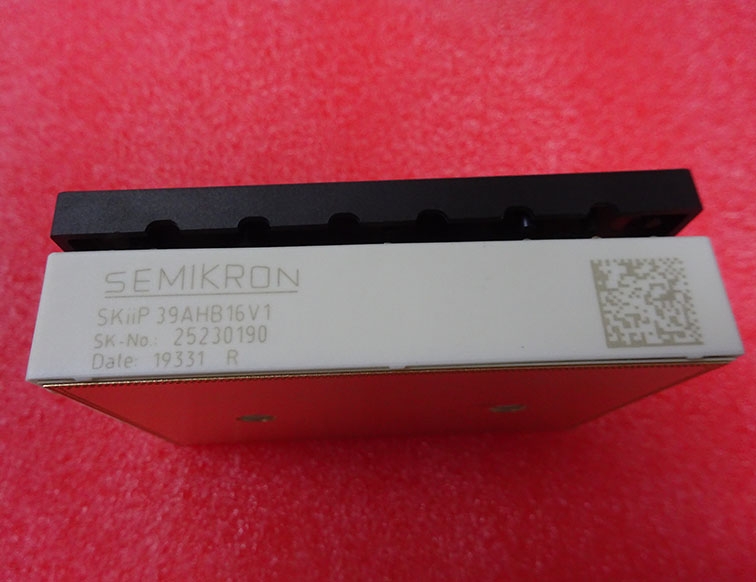
Details
BUY SKIIP39AHB16V1 https://www.utsource.net/itm/p/12613872.html
| Parameter | Description | Min | Typ | Max | Unit |
|---|---|---|---|---|---|
| VDC | Continuous DC voltage | - | 1600 | - | V |
| IC | Continuous collector current (at Tc = 25掳C) | - | 900 | - | A |
| IC (Tc = 80掳C) | Continuous collector current (at Tc = 80掳C) | - | 720 | - | A |
| IC (Tc = 100掳C) | Continuous collector current (at Tc = 100掳C) | - | 630 | - | A |
| IC (Tc = 125掳C) | Continuous collector current (at Tc = 125掳C) | - | 540 | - | A |
| IC (Tc = 150掳C) | Continuous collector current (at Tc = 150掳C) | - | 450 | - | A |
| IC (Tj = 150掳C) | Continuous collector current (at Tj = 150掳C) | - | 360 | - | A |
| IC (Pulsed) | Pulsed collector current (Tj = 150掳C, tp = 10 ms, duty cycle = 1%) | - | 1800 | - | A |
| Eoff | Turn-off energy loss | - | 1.8 | - | mJ |
| Eon | Turn-on energy loss | - | 1.2 | - | mJ |
| Rth(j-c) | Thermal resistance, junction to case | - | 0.15 | - | K/W |
| Rth(j-s) | Thermal resistance, junction to heatsink | - | 0.25 | - | K/W |
| Tjop | Operating junction temperature range | -40 | - | 150 | 掳C |
| Tstg | Storage temperature range | -40 | - | 150 | 掳C |
Instructions for Use:
Mounting:
- Ensure proper mounting to a heatsink to maintain Tj within the specified operating range.
- Use thermal paste or a thermal pad to enhance heat transfer between the module and the heatsink.
Electrical Connections:
- Connect the collector (C), emitter (E), and gate (G) terminals correctly.
- Use short, low-inductance leads to minimize parasitic inductance and improve switching performance.
Thermal Management:
- Monitor the junction temperature (Tj) to avoid exceeding the maximum rating of 150掳C.
- Ensure adequate cooling, especially during high current and high-frequency operation.
Switching:
- Apply a sufficient gate drive voltage to ensure reliable turn-on and turn-off.
- Use a gate resistor to control the switching speed and reduce electromagnetic interference (EMI).
Protection:
- Implement overcurrent protection to prevent damage from excessive current.
- Use snubber circuits to protect against voltage transients if necessary.
Storage:
- Store the module in a dry, cool environment to prevent moisture damage.
- Handle with care to avoid mechanical stress on the terminals and the module body.
Testing:
- Perform initial testing at reduced power levels to verify correct operation and thermal management.
- Regularly inspect the module and connections for signs of wear or damage.
View more about SKIIP39AHB16V1 on main site